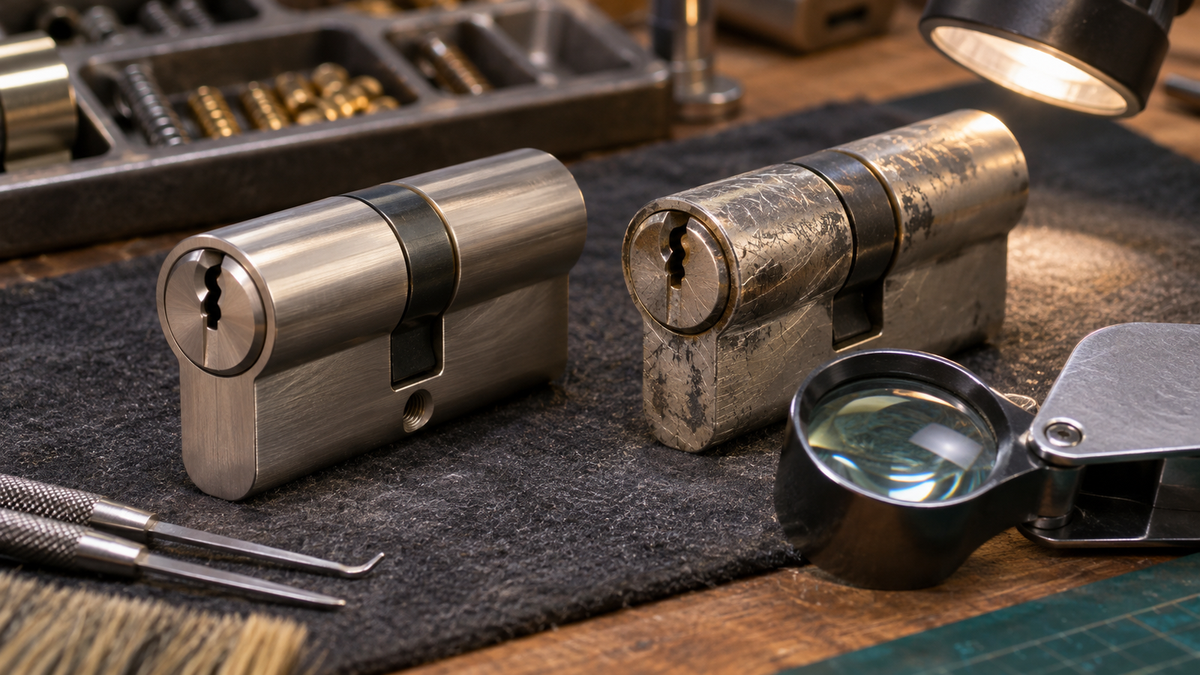
It can. Careful manipulation of a clean, detached practice cylinder may cause little obvious change, but no contact between steel tools and small brass components is literally wear-free. Excessive rotational pressure, aggressive scraping, repeated oversetting, poor tool fit, a snapped pick, dirt, corrosion, or an already worn cylinder can turn minor contact into functional damage. The risk matters most on installed or high-value hardware because a small change can affect reliability, warranty, key operation, or emergency egress. That is why practice belongs on a dedicated trainer, not a front door, vehicle, workplace cabinet, or borrowed padlock. If a lock must remain dependable, use its key and obtain authorized professional service.
What kinds of wear can occur?
Typical concerns include scratches at the keyway, burrs on the plug face, polished or deformed pin surfaces, weakened springs, embedded debris, and distortion from a turning tool that is too thick or heavily loaded. A pick can also break and leave a fragment beyond easy reach. Not every mark changes function, and a rough keyway does not prove picking caused it; keys, dirt, corrosion, poor alignment, and normal use also create wear. The useful question is therefore not whether a mark exists but whether operation has changed. Compare the lock against a known baseline, including key insertion, smooth rotation, plug return, and consistent latching.
Why do tension and tool fit change the risk?
Rotational pressure pushes pin stacks against chamber walls. The minimum pressure needed for readable feedback limits friction and makes pins easier to release. A turning tool that barely fits may twist in the keyway, spread the plug opening, block the working space, or slip unexpectedly. A tool that is too small can also wobble and encourage the user to compensate with force. The correct fit is stable without wedging. Likewise, a hook should reach the intended pin without being levered against the keyway floor. When a learner cannot distinguish feedback, the answer is to reset, improve visibility, or change the trainer, not to press harder.

What are the warning signs to stop immediately?
Stop when the key no longer enters or turns as it did before, the plug fails to spring back, the cylinder feels gritty, metal debris appears, the turning tool remains twisted, the pick develops a kink, or any tool becomes trapped. Also stop when frustration makes movements faster or pressure rises without a clear reason. Do not spray an arbitrary household chemical into the cylinder to free a tool; lubricant requirements differ by design, and incompatible products can hold dust or interfere with electronics. Preserve the parts, note what happened, and follow the lock maker’s instructions or consult a qualified locksmith.
How should a learner document condition?
Before practice, photograph the plug face, test the operating key several times, and record any existing stiffness or looseness. Use the same key and hand position after the session. Count problems, not successful openings: new scraping, inconsistent return, tool deformation, and changes in key feel are more meaningful than speed. A simple session log with date, trainer ID, tools, duration, and observations helps separate gradual wear from a single event. Never use a condition log to justify continued work on installed hardware.
Can a lock still work after being damaged?
Yes. A cylinder may continue to open while becoming less reliable, rougher, or more vulnerable to a future jam. Conversely, a stiff lock may be suffering from door misalignment, a bent key, contamination, cold weather, or installation load rather than internal manipulation. Mul-T-Lock’s maintenance guidance notes that a misaligned door or poorly installed lock can add load and friction that damages cylinders. That is another reason not to diagnose an installed lock by experimenting with picks. A professional can isolate the cylinder, latch, door alignment, and key condition before recommending service or replacement.
How can practice risk be reduced?
Choose a trainer designed to be repinned or replaced, inspect tools for burrs, use a stable vise that does not crush the housing, start with light pressure, and keep sessions short. Clean tools with a soft cloth and store them so thin profiles do not bend. Use only lubricant approved for the specific trainer or cylinder; manufacturer guidance is not universal. Confirm key operation before and after every session. Most importantly, define a retirement threshold in advance. A trainer that becomes gritty, inconsistent, cracked, or difficult with its proper key has stopped being a reliable teaching instrument.
When is replacement safer than more practice?
Replace or professionally service a cylinder when it protects occupied property, has a broken component inside, shows recurring jams, has been exposed to fire or corrosive chemicals, involves an electronic or restricted-key system, or no longer operates reliably with an undamaged correct key. The cost of a trainer is usually smaller than the consequences of a lockout or failed exit hardware.
What is the difference between cosmetic wear and a functional fault?
Cosmetic wear changes appearance without changing normal operation; a functional fault changes insertion, rotation, return, latching, or reliability. The distinction still requires caution because a small burr or fragment may worsen later. Establish a baseline with the proper key and document both feel and function. A faint surface scratch on a retired trainer may be acceptable for continued observation, while a new catch, delayed return, bent key, loose plug, or recurring jam is a reason to stop. Do not file, drill, flush, or disassemble an unfamiliar cylinder to prove that it is safe. Those actions can erase evidence, spread debris, void a warranty, or make the lock less reliable. When the lock has any active security role, a qualified and authorized professional should decide whether cleaning, repair, rekeying, or replacement is appropriate.
Lawful use and professional boundaries
A lock installed on a door, gate, vehicle, locker, cabinet, or other active system can create safety, legal, insurance, and property-damage issues even when the person holding the tools believes the use is harmless. Professional locksmiths also verify identity and authority before opening or servicing a lock. The Associated Locksmiths of America positive-identification policy is a useful model: confirm who is requesting the work, what property is involved, and what authority that person has. Laws governing tools and paid locksmith work vary by state, province, and locality, so readers should check current rules where they live and travel. None of the information here is legal advice. When a lock protects occupied property, supports an emergency exit, contains electronics, is under warranty, or is already malfunctioning, stop and use the correct key, the manufacturer’s service route, property management, or a qualified locksmith.
For help choosing dedicated training hardware, read our practice-lock selection guide.
Frequently asked questions
Will a single practice session ruin a lock?
Not necessarily, but risk is never zero. Use a dedicated detached trainer, light pressure, smooth tools, and a working key for before-and-after checks.
Can scratches prove a lock was picked?
No. Keys, dirt, corrosion, installation, and ordinary wear can also leave marks. A qualified examination considers the full context.
What should I do if a pick breaks inside?
Stop turning or probing. Preserve the lock and fragment, then follow manufacturer guidance or use an authorized locksmith to avoid driving the piece deeper.
Is lubricant a quick fix after rough practice?
Not by default. Products and intervals differ among lock makers. Use only guidance for the exact cylinder and do not use lubricant to conceal a developing fault.
