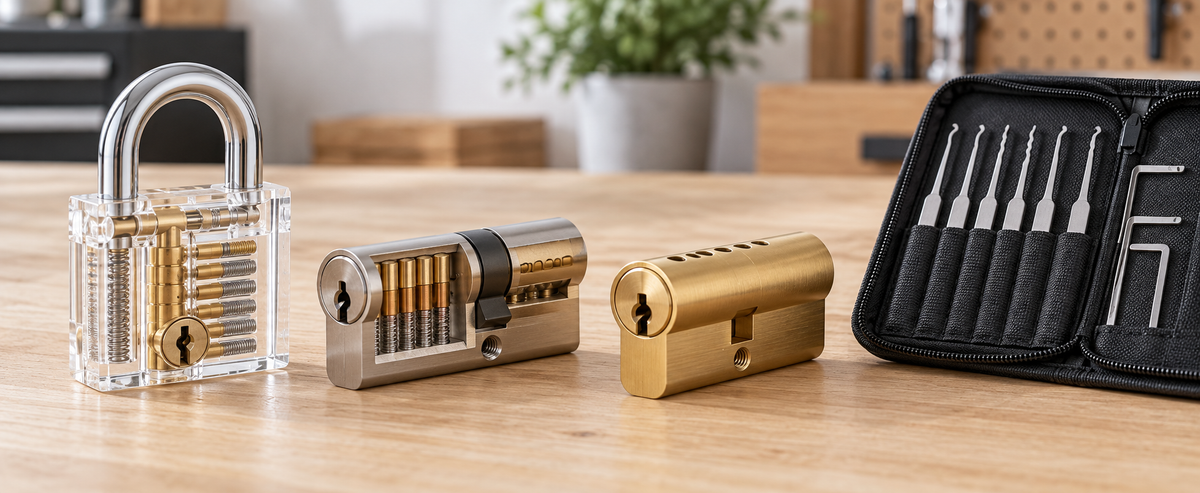
The best practice lock is one that makes progress visible, repeatable, and safe. A complete beginner may learn fastest with a transparent or cutaway model, while a learner who understands basic pin movement will usually get more value from a repinnable metal cylinder. Whichever format you choose, use it only as dedicated training equipment and never practice on a lock that protects a door, vehicle, cabinet, or other property in use.
That distinction matters because lock picking is a hands-on study of how a lock responds, not simply a race to make a plug turn. A useful practice lock lets the learner connect what is seen, felt, and heard, then increase difficulty without guessing. This guide focuses on lawful training, locksport, and authorized professional education; it does not provide entry or bypass instructions.
What Is a Practice Lock?
A practice lock is a lock reserved for training rather than security. It may expose internal components, accept different pin configurations, or simply be a standard lock removed from service and clearly labeled for practice. Its purpose is to let a learner repeat exercises without risking a lock that protects people or property.
This is also the ethical baseline. The Open Organisation of Lockpickers tells members to manipulate only locks they own or have explicit permission to use and to follow the laws that apply in their jurisdiction. University of Notre Dame workshop guidance adds a practical rule: do not pick a lock that is in use. Laws on possession, carrying, training, and paid locksmith work vary by state, province, and municipality. TOOOL rules of ethics Notre Dame workshop guidance
Which Type of Practice Lock Should a Beginner Choose?
Most beginners should start with a lock that explains cause and effect, then move to a metal, repinnable model that supports gradual difficulty. No single format does every job well, so choose according to the next skill you need to understand rather than the largest accessory count.
| Type | Best use | Main advantage | Limitation |
|---|---|---|---|
| Transparent acrylic | First visual orientation | Shows component movement clearly | Feedback and durability differ from metal locks |
| Cutaway metal | Connecting sight with touch | Keeps realistic materials while exposing part of the mechanism | The viewing window can become a crutch |
| Repinnable metal | Progressive practice | Difficulty can change without replacing the lock | Requires organized parts and careful setup |
| Standard retired lock | Transfer and variety | Provides realistic variation among everyday cylinders | Harder to diagnose mistakes; must never be in use |

Transparent Practice Locks
A transparent practice lock is best treated as a short-term teaching model. The clear body helps a new learner identify the plug, pin stacks, springs, and shear line, and it can make an instructor’s explanation easier to follow. The tradeoff is realism: acrylic bodies wear differently from brass or steel, and the learner may rely on sight instead of developing consistent tactile feedback.
Cutaway Practice Locks
A cutaway practice lock is usually the strongest bridge between demonstration and realistic practice. A portion of the metal cylinder is removed so internal movement remains visible while the learner still handles a metal mechanism. Choose a viewing window large enough for instruction but small enough that the lock still feels like a training tool, not a display object.
Repinnable Practice Locks
A repinnable practice lock offers the best long-term value when its chambers can be configured from simpler to more varied arrangements. Controlled changes let the learner isolate one source of difficulty at a time, repeat a setup, and record what changed. Look for secure access to the chambers, replacement parts that are easy to organize, and clear documentation for returning the cylinder to a known configuration.
Standard Locks Reserved for Training
A retired padlock or removable cylinder can add realistic variety after the learner understands the basics. It should be owned by the learner, removed from service, functional with its key, and permanently marked as practice equipment. Avoid door locks, vehicle locks, or any lock whose failure could create a safety, access, or property-security problem.
What Features Matter Most in a Practice Lock?
The most useful features are adjustable difficulty, realistic construction, repeatability, and compatibility with a safe workspace. Focus on these criteria:
- Progression: The lock should support an easier starting configuration and meaningful increases in difficulty.
- Construction: Metal components generally provide more representative wear and feedback than an all-acrylic body.
- Reset access: A repinnable model should open for configuration without forcing or damaging the housing.
- Stability: The lock should sit securely in the hand, a small vise, or a purpose-built stand without awkward strain.
- Documentation: A parts list and configuration record make practice repeatable instead of random.
- Key control: Keep a working key with the lock so you can confirm normal operation before and after a session.
How Should a Practice Lock Match a Beginner Tool Set?
A beginner training setup should favor a few clearly identified tools over a crowded case. For a common pin-tumbler practice lock, the essential categories are a turning tool and a small selection of basic picks suited to the keyway. Extra profiles are useful only when the learner can explain what problem each one solves. Compatibility, comfortable handling, smooth edges, and clear labeling matter more than the advertised piece count.
A practice lock and tool set should also leave room for observation. The classic MIT Guide to Lock Picking emphasizes practice exercises as the way to learn how lock defects feel. For modern training, that means using a repeatable setup, changing one variable at a time, and recording results rather than applying more force when feedback is unclear. MIT Guide to Lock Picking
A Safe Progression for Practice
A good training progression moves from understanding to consistency, then to variety. Keep the work on a bench or table and stop if a lock binds, deforms, or no longer works normally with its key.
- Learn the parts. Use a diagram, transparent model, or cutaway to identify the components and understand what the key normally does.
- Build repeatability. Use one known training configuration until you can recognize its feedback consistently.
- Increase one variable. Add complexity gradually rather than changing the lock, tools, grip, and setup at the same time.
- Transfer carefully. Move to a retired, clearly marked training lock only after the visual model is no longer doing the thinking for you.
- Review the record. Note the configuration, time spent, problems observed, and whether the key still operates normally.
Common Practice-Lock Buying Mistakes
The most common mistake is buying for quantity instead of learning value. A large bundle may look comprehensive while offering no sensible progression. Watch for these warning signs:
- A transparent lock is presented as the only lock a learner will ever need.
- The difficulty cannot be adjusted and the internal configuration is not documented.
- The product does not include or identify a working key.
- Replacement pins, springs, or compatible components are impossible to identify.
- The description encourages use on installed or active locks instead of dedicated training equipment.
How to Build a Responsible Practice Station
Keep the setup simple: a dedicated practice lock, its key, a limited set of compatible tools, a parts tray, eye protection when handling springs, and a notebook. Label every training lock “PRACTICE ONLY” and store tools according to local rules. If a lock protects anything, leave it alone. For a lockout, damaged cylinder, or paid service request, use a properly qualified locksmith rather than turning the situation into a practice session.
Tumzaro Product Discovery Guide
When reviewing Tumzaro’s current catalog, start with the training goal: visual orientation, realistic feedback, or adjustable progression. Then confirm the lock material, reset method, included key, compatible tool category, replacement-part availability, and storage needs. Choose the smallest setup that supports the next stage of learning, and add variety only when the first lock no longer answers the learner’s questions.
For visual orientation, compare Tumzaro’s Starter 17 + 1 Kit, which includes a transparent practice padlock, with the Starter 17 + 2 Kit, which includes a transparent padlock and a double-ended cylinder. These clear training formats serve the visual-learning stage described above; they should not be confused with metal cutaway or repinnable practice locks. Check each product page for the current contents and storage options.
FAQ
Are transparent practice locks good for beginners?
Yes, for learning the names and movement of internal components. They are less useful as a long-term benchmark because acrylic construction and constant visibility can produce habits that do not transfer cleanly to metal locks.
Is a cutaway lock better than a transparent lock?
A cutaway metal lock is usually better for connecting visual information with realistic feedback. A transparent lock is often easier for the first explanation, so the two formats serve different stages.
What makes a repinnable practice lock worth buying?
It can support controlled progression. The learner can repeat a known configuration, change one variable, and keep using the same housing as skills develop.
Can I practice on my own front-door lock?
No. A lock in use can be worn, damaged, or left in an unreliable state. Use a dedicated training lock removed from service, and contact a qualified locksmith for an actual lockout or repair.
Are lock-picking tools legal in the United States and Canada?
Rules vary by jurisdiction and context, including possession, carrying, intent, professional licensing, and sales. Check current state, provincial, and local law before buying, carrying, teaching with, or using the tools.
