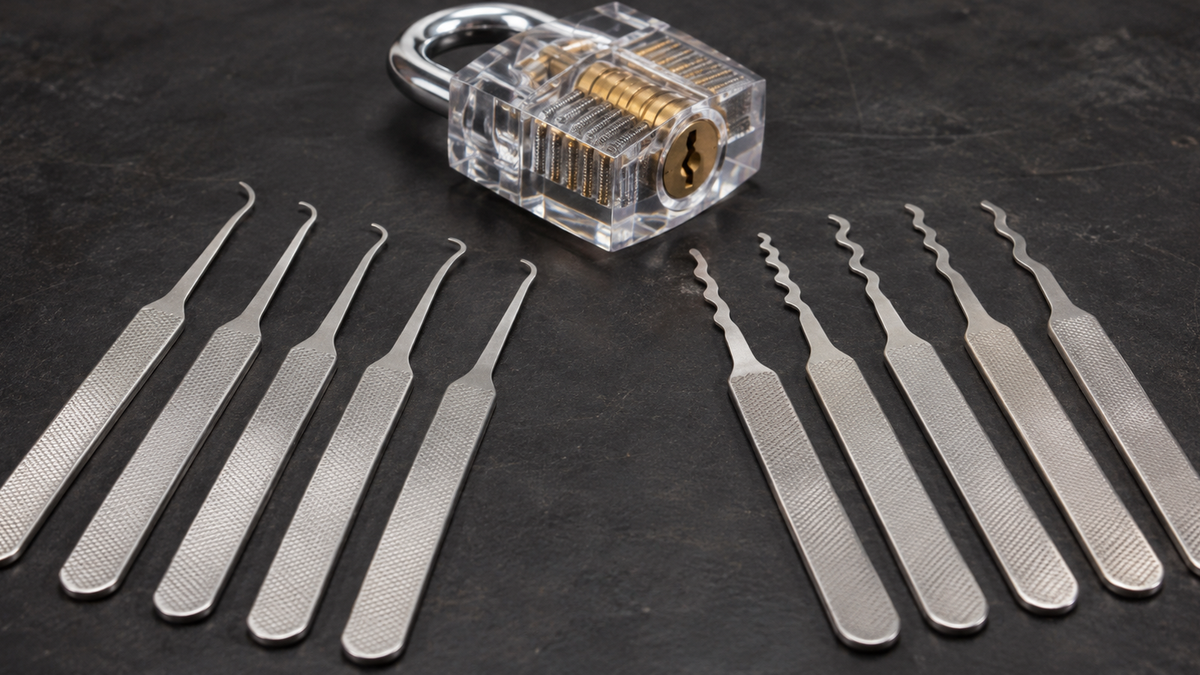
A hook is shaped to contact one pin at a time, while a rake uses peaks and valleys to influence several pins during a controlled motion. In lawful practice, hooks support deliberate pin identification and teach how tension, reach, and feedback relate. Rakes can demonstrate how groups of pins respond to changing height and motion, and may provide a quick indication that a simple trainer is responsive. Neither profile is a master key, and neither guarantees an opening. Keyway shape, pinning, tolerances, tool thickness, tension, wear, and the learner’s control all matter. Choose the profile that serves the lesson, not the one advertised as fastest.
What does a hook teach?
A short or medium hook encourages the learner to map pin positions, isolate one chamber, and compare springy, binding, set, and overset states. That makes it a strong foundational tool for understanding pin tumbler mechanics. A lower hook can be easier in an open keyway, while a deeper curve can reach behind obstacles or lift a high pin, provided there is enough space. More curve is not automatically better; an oversized hook may rub the warding, overshoot a pin, or demand awkward leverage. Start with the simplest profile that reaches every pin in the detached trainer without scraping heavily.
What does a rake teach?
A rake emphasizes patterns, rhythm, and tension response rather than isolated pin control. Wave and city-style profiles contact pins differently, so a learner can observe how small changes in angle and pressure affect a basic practice cylinder. The educational value is feedback comparison, not speed. Raking can also conceal errors because multiple contacts make it harder to know which pin moved or why a reset occurred. For that reason, use a transparent trainer and return to a hook when the response becomes ambiguous. Avoid prolonged aggressive motion, which increases abrasion and teaches force instead of control.

Which profile is better for beginners?
For durable skill, a basic hook is usually the better primary teacher because it links a single movement to a single pin. A rake can be a useful secondary profile for demonstrating group interaction and exploring tension changes. A balanced first training set therefore needs only a few well-finished shapes, not a large catalog of near-duplicates. Beginners should judge success by repeatable observations: Can they identify the back pin? Can they release pressure without dropping everything? Can they explain why they reset? An opening without an explanation is less useful than a failed attempt that produced clear feedback.
How do keyway fit and finish affect both tools?
Thickness must suit the keyway while leaving room for controlled movement. A wide, open trainer may accept a thicker tool that feels rigid; a restricted keyway may require a thinner profile, which needs gentler handling. Edges should be smooth enough not to cut the user or scrape excessively, but the exact finish is a manufacturer and tool-care question. Inspect tips for twists, burrs, cracks, and asymmetry before every session. A well-shaped inexpensive tool that fits the trainer is more useful than an elaborate profile that continually rubs the warding or cannot reach the intended pin.
How should tension differ between hook and rake practice?
Both methods require controlled rotational pressure, but the motion changes how that pressure feels. Hook practice often uses steady light pressure with deliberate releases. Rake practice may need even more attention to pressure because several pins are moving and can bind at once. Do not compensate for a poor response by increasing both pick speed and turning force. Change one variable, observe the result, and reset. If a tool begins to chatter against metal, the cylinder feels gritty, or the pick bends, stop. Training should preserve the trainer and the tools while making feedback easier to interpret.
What is a sensible progression?
Begin by operating the trainer with its key and observing the pin stacks. Map the chambers with a basic hook under no tension. Add light rotational pressure and practice identifying one binding pin without attempting a full opening. Once those states are recognizable, compare a few gentle rake motions in the same trainer and note how the feedback differs. Return to the hook to understand what the rake changed. Later, use a repinnable trainer to add one known variable at a time. This progression creates a repeatable experiment and avoids using household security hardware as a test.
How should you choose a set?
Prioritize a comfortable handle, smooth consistent profiles, dimensions suited to your authorized trainers, a protective case, and enough tension-tool variety for stable fit. Avoid choosing solely by piece count or claims of universal compatibility.
How can a comparison avoid misleading conclusions?
For a fair comparison, keep the trainer, tension tool, session length, and starting condition constant, then change only the pick profile. Confirm key operation between trials and allow the lock to reset fully. A rake that produces an opening once has not proven universal superiority, and a hook that feels slow may be revealing more useful information. Repeat observations across more than one authorized trainer and note where the profile rubs, which pins it can reach, and how easily the user can explain the result. Retire a damaged tool rather than including it in the comparison. This simple experimental discipline separates profile effects from fatigue, luck, tension changes, and differences in lock condition. It also produces more honest buying guidance: select a profile for a defined lesson and compatible keyway, not for a promise that cannot be generalized.
Lawful use and professional boundaries
A lock installed on a door, gate, vehicle, locker, cabinet, or other active system can create safety, legal, insurance, and property-damage issues even when the person holding the tools believes the use is harmless. Professional locksmiths also verify identity and authority before opening or servicing a lock. The Associated Locksmiths of America positive-identification policy is a useful model: confirm who is requesting the work, what property is involved, and what authority that person has. Laws governing tools and paid locksmith work vary by state, province, and locality, so readers should check current rules where they live and travel. None of the information here is legal advice. When a lock protects occupied property, supports an emergency exit, contains electronics, is under warranty, or is already malfunctioning, stop and use the correct key, the manufacturer’s service route, property management, or a qualified locksmith.
For help choosing dedicated training hardware, read our practice-lock selection guide.
Frequently asked questions
Is raking always faster than using a hook?
No. Results depend on the trainer, pinning, fit, tension, and user control. Speed is not a dependable selection criterion.
Do I need many hook depths?
Not initially. Start with a basic profile that can reach all pins in the chosen trainer, then add another depth only when a documented access problem requires it.
Can a rake damage a practice lock?
Aggressive or prolonged motion can increase abrasion, especially with rough tools or heavy tension. Use gentle controlled movement and stop when operation changes.
Should I learn raking or single-pin work first?
Learn basic pin states and tension with a hook first, then use a rake as a comparison tool. That sequence makes the broader feedback easier to understand.
