Use lock tools only on locks you own or are specifically authorized to service. Possession, licensing, and use rules vary by state, province, and locality. When a lock protects an occupied building, vehicle, workplace, or shared property, stop and use an authorized locksmith or the responsible property manager.
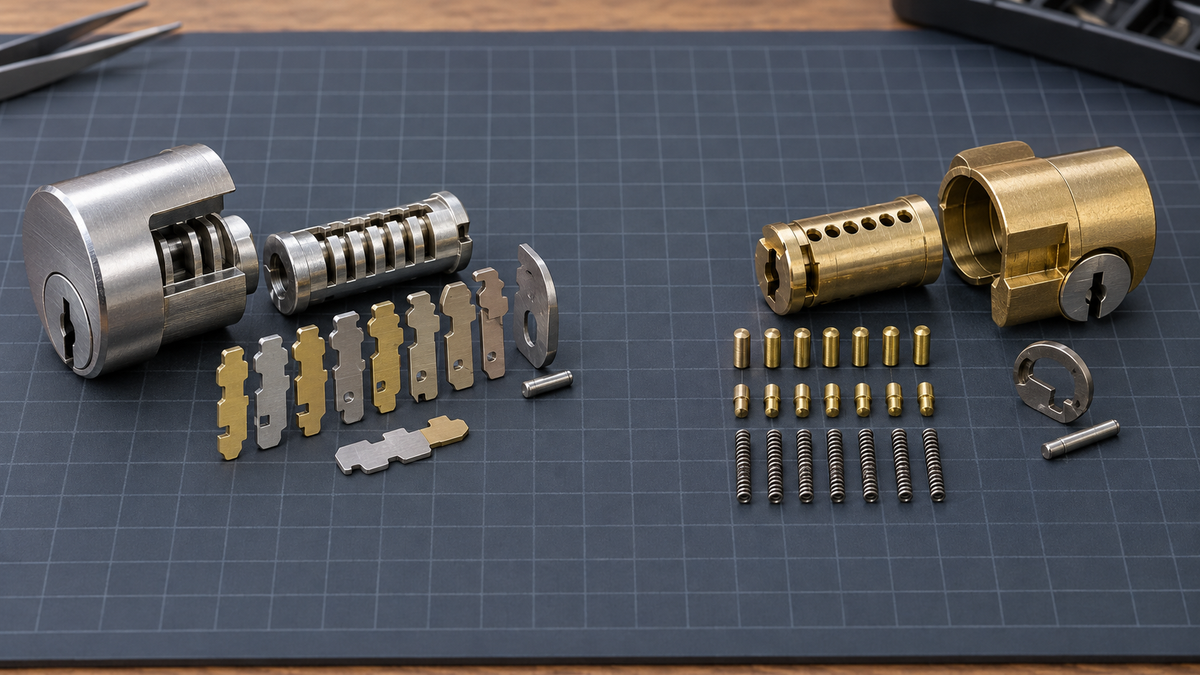
A wafer lock is a mechanical lock that uses flat, spring-loaded wafers instead of the paired round pins found in a conventional pin-tumbler cylinder. The correct key positions each wafer so it no longer projects into the housing, allowing the plug to rotate. Wafer locks are common in compact, cost-sensitive applications such as cabinets, desks, equipment enclosures, luggage, and some vehicle or utility hardware, although the exact design and security level vary widely. Understanding the mechanism helps buyers choose the right service and training tools and prevents the common mistake of treating every keyway as a pin-tumbler lock. This article explains the parts, key styles, uses, and selection criteria at a safe educational level. Any hands-on work should be limited to a detached practice lock or hardware you are specifically authorized to service.
What is a wafer lock?
A wafer lock, also called a wafer-tumbler lock, contains one or more thin wafers that slide across the plug under spring pressure. Without the correct key, part of a wafer extends beyond the plug and blocks rotation against the shell. The key's cuts move the wafers until their outer edges sit flush with the plug. Allegion's technical explanation identifies the plug housing, shell, cam, and retainer as common parts and notes that wafers may be arranged on one side or both sides. A single-bitted key acts on one row; a double-bitted key can act on wafers from two directions. The term describes a family rather than one universal construction. Wafer count, key profile, spring layout, materials, tolerances, and the device driven by the cam all differ, so a tool or replacement cylinder must be matched to the actual lock.
How does a wafer lock differ from a pin tumbler lock?
The main difference is the locking element. A wafer mechanism uses flat, usually one-piece sliders; a pin-tumbler mechanism uses a key pin and driver pin in each chamber. Yale explains that the correct key raises pin pairs so their gaps align at the plug boundary. In a wafer lock, the correct key instead centers each wafer at that boundary. The keys often look different as a result. Wafer keys commonly have squarer, stepped cuts and may be shorter; pin-tumbler keys often have angled edge cuts. These are general patterns, not a reliable identification rule. Some locks combine features or use unfamiliar profiles. From a service perspective, pin and wafer tools are not automatically interchangeable. An oversized tool can bend a wafer or jam a narrow keyway, while assumptions based only on the key can lead to the wrong replacement part.
Where are wafer locks commonly used?
Wafer locks are widely used where compact size, simple keying, and moderate cost matter. Allegion lists desks, cabinets, filing cabinets, padlocks, trailer doors, trunks, and suitcases among common applications. Cam locks are a familiar example: the rotating plug moves a flat cam that secures a panel or drawer. Automotive locks have also used wafer mechanisms, though modern vehicles can combine mechanical, transponder, sidebar, and electronic systems. Application does not determine quality by itself. A robust industrial cabinet cylinder and a light luggage lock may both use wafers but have very different construction and consequences of failure. For security decisions, evaluate the complete assembly, the value and risk of the asset, resistance to force, key control, installation, and whether the lock is intended as a primary barrier or a convenience closure.

What feedback does a wafer lock provide in training?
In an authorized practice lock, a wafer can feel like a spring-loaded slider that moves across the keyway rather than a pin moving vertically in a round chamber. Single- and double-sided layouts change where those elements are encountered. The educational goal is to identify the mechanism, maintain tool clearance, and understand how the correct key centers the wafers. It is not to memorize a quick opening sequence. Use a detached, replaceable practice cam lock whose construction and ownership are known. Begin by studying the working key and observing the cam with the lock removed from service. If the exercise includes non-destructive manipulation, follow an instructor or manufacturer plan and stop at abnormal resistance. Thin wafers can bend, springs can dislodge, and the cam can trap parts if the plug is rotated or dismantled incorrectly.
How should wafer-lock tools be selected?
Select tools by keyway width, wafer layout, training objective, and manufacturer guidance. A basic inspection light and a small set of smooth, thin profiles are more useful than a crowded kit with unidentified pieces. The tool must enter without spreading the keyway or scraping both walls. Rounded, polished edges improve control; sharp stamping marks can catch springs or score soft components. A tension tool must fit the plug without blocking access or contacting the housing. For service work, technicians may also need pinning tweezers, followers, clips, or model-specific fixtures, but those belong in trained disassembly workflows. Avoid universal compatibility claims. Before purchase, confirm whether the product is intended for single-sided wafers, double-sided wafers, automotive work, or general bench training, and verify that local rules permit possession and use.
What are the limits of a wafer lock?
A wafer mechanism is neither automatically weak nor automatically suitable for high security. Low-cost versions may have fewer wafers, generous tolerances, soft materials, exposed cams, or limited resistance to force. Better products can use improved materials, tighter tolerances, protected mounting, more complex keying, and integrated housings. The surrounding enclosure often matters as much as the cylinder: a strong lock on a flexible cabinet door may not meaningfully improve protection. Likewise, a restricted key policy, inventory, and prompt response to lost keys can matter more than the internal element alone. Choose a lock based on a risk assessment and recognized performance information from the manufacturer or applicable standard. For an occupied building or high-value asset, use a qualified security professional rather than extrapolating from a training lock.
How should wafer locks be maintained?
Keep the key clean and retire bent or heavily worn copies. If operation becomes rough, inspect door, drawer, or cam alignment before adding lubricant; mechanical load can make a healthy cylinder feel defective. Follow the lock maker's cleaning and lubrication directions because products suitable for one material or environment may leave residue in another. Do not flood a wafer lock, mix lubricants, or scrape the keyway with improvised objects. Detached training locks should be stored dry, labeled with their key and configuration, and inspected for bent wafers or loose retainers after class. If a working cylinder sticks, loses key retention, or allows the key to withdraw in an unintended position, stop using it and arrange authorized service. Maintenance should restore reliable operation, not become an opportunity for unapproved experimentation.
What should be documented before wafer-lock service or training?
Photograph the face, cam orientation, retainers, and key before parts are moved. For a class, assign an inventory number and keep the matching key with the training cylinder. For professional service, note existing damage and confirm how the enclosure will remain secure while the lock is out. Documentation protects the client, technician, and learner from later confusion. It also makes results repeatable: if feedback changes, the record shows whether a wafer, spring, cam, or tool configuration changed. Never place sensitive key codes or access details in an unsecured handout or public post. Store service records according to the property owner's policy and applicable privacy requirements.
A practical product-discovery path
A useful wafer-lock training setup begins with a detached, clearly identified practice cam lock, its working key, one or two polished tool profiles, and a correctly fitting tension tool. Automotive or institutional work needs separate authorization, training, and model-specific equipment.
Frequently Asked Questions
Are wafer locks the same as pin tumbler locks?
No. Wafer locks use flat sliding wafers, while pin-tumbler locks use paired pins. Both block plug rotation until the correct key aligns their locking elements.
Are all car locks wafer locks?
No. Vehicle systems vary by model and year and may combine wafers, sidebars, electronics, and transponders. Use trained, authorized automotive service.
Can a wafer lock be rekeyed?
Some models can be serviced or reconfigured; others are replaced as a unit. Follow the manufacturer's procedure and use a qualified locksmith for installed hardware.
What is a double-sided wafer lock?
It has wafers acted on from more than one side of the key, typically corresponding to cuts on both edges. Construction varies by manufacturer.
Sources
- Allegion Knowledge Center: What is a wafer lock? (Accessed 2026-11-01; describes flat wafers, single- and double-bitted designs, parts, and common applications.)
- Yale Pin-tumbler Invention (Accessed 2026-11-01; explains the contrasting pin-tumbler mechanism.)
