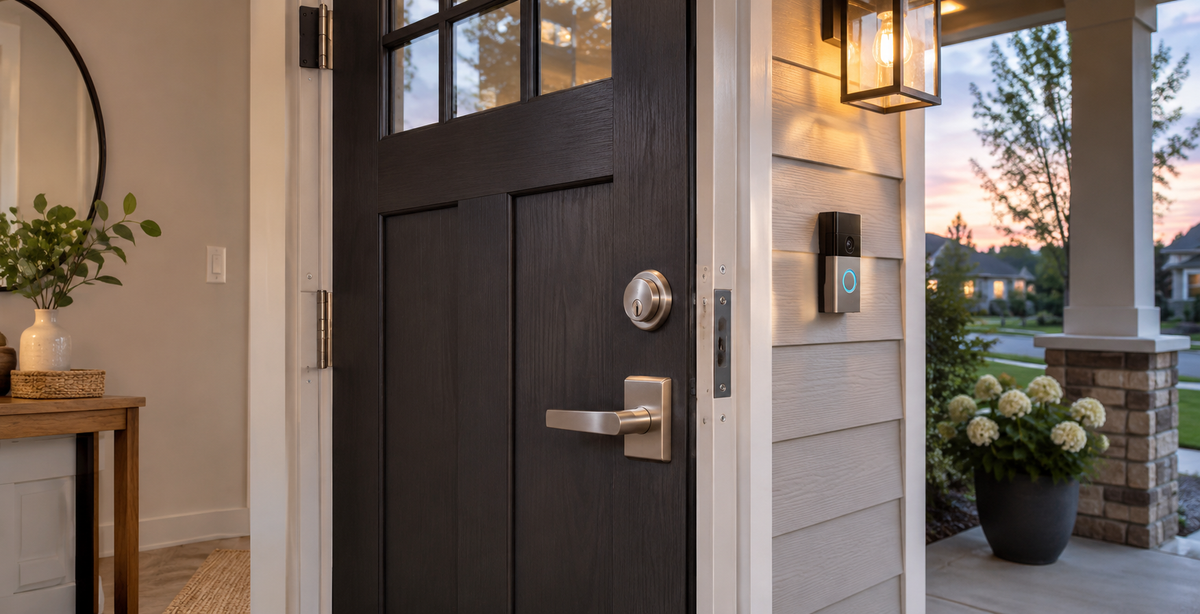
A door lock cannot be made literally impossible to pick, but a homeowner can make picking slower, less predictable, and less attractive by choosing independently evaluated hardware and strengthening the entire doorway. The practical goal is layered security: a pick-resistant cylinder, a correctly installed deadbolt, a reinforced strike and frame, controlled keys, lighting, and monitoring. Each layer covers a different failure point.
This matters now because North American police are again emphasizing property protection as darker evenings and seasonal travel return. Recent U.S. and Canadian guidance recommends quality locks, reinforced strike plates, locked doors and windows, motion lighting, cameras, and neighbor awareness. Those recommendations point to the same conclusion: protecting a home is a system decision, not a single-product decision.
Can You Make a Door Lock Pick-Proof?
No lock should be described as pick-proof. Cylinders vary in resistance, and results depend on design, keying, installation, wear, and the skill and access of the person attacking them. An archived 2018 BHMA committee-review appendix states that all cylinders resist picking to varying degrees and that measuring pick resistance involves many variables.
That same archived appendix says cylinder picking ranks low statistically among unauthorized-entry methods. This does not mean pick resistance is irrelevant. It means a homeowner should not spend the entire security budget on the keyway while leaving a weak strike plate, hollow exterior door, exposed glass, or unlocked window as an easier path.
A useful security question is therefore not “Can this lock be picked?” but “Does this doorway resist several realistic forms of unauthorized entry long enough to deter, reveal, or delay an attempt?”
Which Lock Features Reduce Picking Risk?
Pick resistance starts with the cylinder, the keyed component that accepts the key and controls the deadbolt or latch. Better cylinders may use tighter manufacturing tolerances, pick-resistant pin designs, complex keyways, hardened components, or controlled key systems. These features can increase difficulty, but a feature list is not the same as independent evaluation.
Look for evidence that matches the claim
For a higher-security application, ask a qualified locksmith for documentation tied to the exact cylinder model. ANSI/BHMA A156.30 covers high-security cylinders, while ANSI/BHMA A156.39 and A156.40 address residential locksets and deadbolts. The labels are related to different product scopes, so a general residential grade should not automatically be read as a specific pick-resistance claim.
The archived appendix’s guidance for applications requiring pick and drill resistance points to Grade 1 cylinder performance under ANSI/BHMA A156.5 together with UL 437 testing and listing or labeling by a nationally recognized independent laboratory. UL also advises checking the certification category and intended application, because a mark is meaningful only in the context of the standard and product covered.
Control legitimate keys too
Key control often deserves attention before a cylinder upgrade. Rekey or replace locks after moving, after a key is lost, or when an untrusted person may still have a copy. Do not hide spare keys outdoors. Limit who can duplicate or borrow them, and keep a simple record for rental, office, or shared-property keys. A sophisticated cylinder cannot protect against an unauthorized working key.

Why Does the Door Frame Matter as Much as the Cylinder?
The cylinder controls the bolt, but the door, strike, frame, hinges, fasteners, and surrounding wall must hold it in place. A high-security cylinder installed in a weak assembly simply shifts the easiest failure point. The archived BHMA appendix explicitly warns that lock evaluation does not account for every door and frame, and recommends compatible components and fasteners long enough to engage structural framing.
| Threat or weakness | Primary control | Why it matters |
|---|---|---|
| Cylinder manipulation | Documented pick-resistant or high-security cylinder | Adds resistance at the keyway; verify the exact model and applicable standard. |
| Door or frame force | Deadbolt, reinforced strike, sound jamb and structural fastening | Prevents a strong cylinder from being defeated by a weak assembly. |
| Uncontrolled key copy | Rekeying and key-control practices | Removes access from lost, copied, or unreturned working keys. |
| Unobserved approach | Lighting, cameras, alarms and neighbors | Raises visibility and may deter or document suspicious activity. |
Police guidance supports this system view. The Baltimore Police Department recommends a deadbolt on every exterior door and three-inch screws anchoring the strike to the house framing. Sacramento Police likewise notes that a deadbolt is only as good as the door and frame in which it is installed. Exact hardware and screw choice should match the door construction, fire rating, lease terms, and local code, so uncertain installations belong with a licensed or otherwise qualified local professional.

What Is a Practical Layered Door-Security Checklist?
Start with the easiest weaknesses and verify each layer in order. The following checklist is defensive and does not require testing a live lock with picking tools.
- Confirm that every exterior door has a properly fitted deadbolt and that the bolt fully enters the strike without forcing or rubbing.
- Check that the strike, jamb, and surrounding frame are solid, tight, and appropriate for the door; have damaged wood or loose hardware repaired.
- Ask for the exact cylinder model, its certification or test documentation, and whether the claimed resistance covers picking, drilling, key control, or another attack type.
- Rekey after a move, turnover, lost key, or uncertain key history; never rely on a hidden outdoor spare.
- Secure nearby windows, sliding doors, garage entries, and outbuildings so the front-door cylinder is not the only hardened point.
- Use motion-activated exterior lighting, visible cameras or alarms where lawful, and timed indoor lights when away.
- Arrange mail and package collection and ask a trusted neighbor or house sitter to watch the property during travel.
- Keep emergency egress clear. Do not add an interior lock arrangement that can trap occupants or conflict with fire and building codes.
The checklist reflects October 2026 guidance from Fairfax County Police and the Royal Canadian Mounted Police. Fairfax recommended deadbolts, reinforced strike plates, motion lighting, key control, and routine security reviews. Coquitlam RCMP recommended secured doors and windows, motion lighting, cameras, and a trusted neighbor or sitter. Alberta RCMP added a seasonal reminder to secure unattended buildings and use cameras or lighting where appropriate.
How Should You Assess an Existing Lock Without Damaging It?
Use a visual and operational inspection, not a picking test on an installed lock. Confirm that the key turns smoothly, the bolt extends fully, the door does not need to be lifted or pushed to lock, and the hardware is not loose. Look for cracked jamb material, a small or poorly secured strike, exposed gaps, corrosion, and keys that are bent or badly worn.
Do not practice lock picking on a door, vehicle, rental unit, or lock that protects property. Even with permission, an installed lock can be damaged or left unreliable. Lawful training belongs on separate practice hardware that you own or are explicitly authorized to use, in a controlled setting where failure will not create a safety or access problem.
When Should You Call a Locksmith or Door Professional?
Call a qualified local professional when the door is misaligned, the frame is damaged, the property has an unknown key history, you need documented high-security hardware, or an installation may affect fire egress, accessibility, insurance, or a lease. A good assessment should identify the weakest component first and explain which standard, certification, or application supports each recommendation.
If you suspect an attempted entry, do not disturb the area or try to diagnose the method yourself. Move to a safe location and contact local law enforcement. Preserve camera footage and photographs only when it is safe to do so.
A Safer Learning and Product-Discovery Path
Separate home protection from lock-picking practice. For home security, begin with a professional doorway assessment and verified hardware documentation. For locksmith education or locksport, use owner-authorized practice locks and tools matched to the training lock type. That separation protects the real door, keeps training lawful, and makes it easier to evaluate skill without risking a lock you depend on.
Frequently Asked Questions
Do security pins make a lock impossible to pick?
No. Security pins can complicate manipulation, but resistance also depends on the full cylinder design, tolerances, keying, installation, wear, and attacker skill. Treat them as one feature, not a guarantee.
Does a smart lock eliminate lock-picking risk?
Not necessarily. Many smart locks retain a mechanical key cylinder for backup, so the cylinder still matters. Electronic locks also introduce power, software, account, and installation considerations. Review every access method, not just the keypad or app.
Should I test my front-door lock with lock picks?
No. Testing an installed security lock can damage it or leave it unreliable. Use separate practice hardware that you own or have explicit permission to test, or hire a qualified locksmith for a non-destructive security assessment.
Is replacing the cylinder enough?
Only when the rest of the assembly is already sound. The deadbolt, strike, fasteners, jamb, door, hinges, glazing, and adjacent entry points must support the same security goal.
