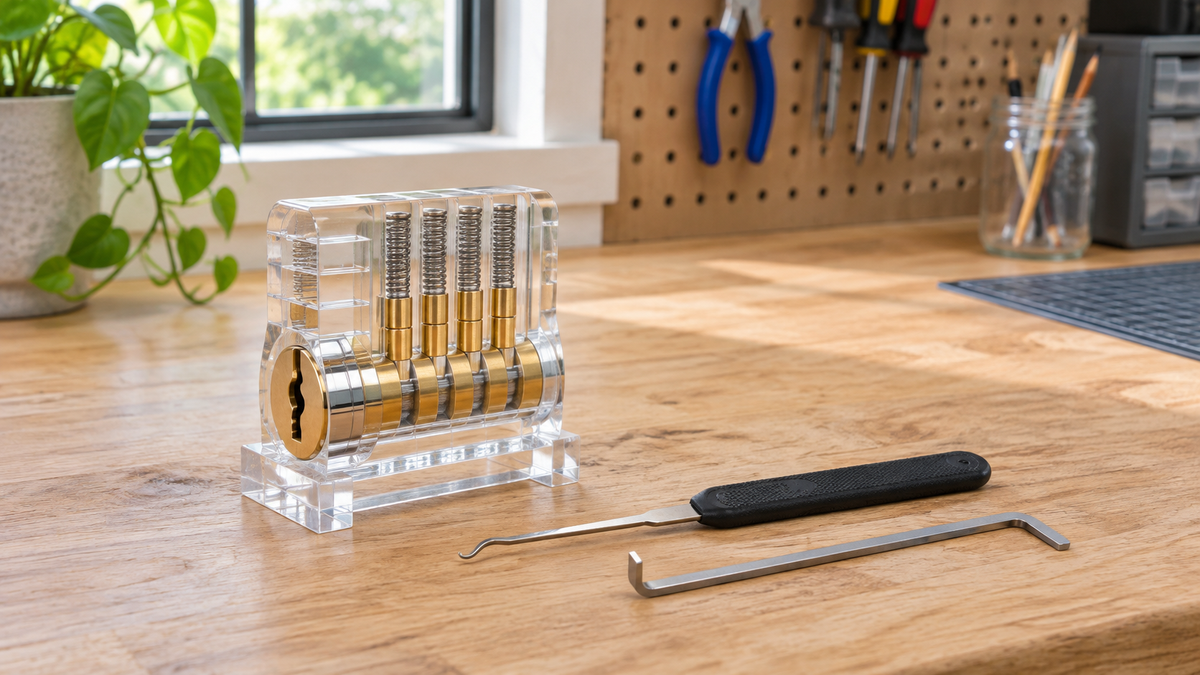
Use lock tools only on locks you own or are specifically authorized to service. Possession, licensing, and use rules vary by state, province, and locality. When a lock protects an occupied building, vehicle, workplace, or shared property, stop and use an authorized locksmith or the responsible property manager.
A false set is a small, misleading rotation of a pin-tumbler lock's plug that occurs before the lock is open. It usually appears when a shaped security pin, such as a spool or mushroom pin, catches at the shear line while other pins are already positioned. The plug may turn a few degrees and feel promising, but the cylinder has not completed its normal opening rotation. For a lawful learner, that moment is useful feedback: it shows that tension, binding order, and pin shape are interacting. It is not proof that more force is needed. The safest place to learn the sensation is a transparent or progressively pinned practice lock that you own, not a door, vehicle, cabinet, or lock currently protecting property. This guide explains the concept, the mechanics behind it, and a measured way to interpret the signal without turning a training exercise into damaged hardware.
What does a false set mean in lock picking?
A false set means the plug has rotated into a temporary position created by the geometry of a security pin. In an ordinary pin-tumbler cylinder, the correct key raises each pin pair so the gap between the key pin and driver pin aligns with the edge of the plug, commonly called the shear line. Yale's explanation of the pin-tumbler mechanism describes this alignment as the condition that allows the plug to rotate. A false set looks similar from the outside because the plug moves, but at least one pin is still blocking full rotation. The movement is therefore diagnostic, not a successful opening. It may feel deeper than ordinary springiness and may remain when pressure is held. Because lock designs and wear vary, plug movement alone cannot identify a particular pin with certainty. Learners should combine the observation with a clear practice lock, a training log, and light, repeatable inputs rather than treating every movement as the same signal.
Why do security pins create false sets?
Security pins are driver pins or other components shaped to complicate manipulation while still working normally with the correct key. Common training examples include spool-shaped and mushroom-shaped drivers. ABUS describes mushroom pins as housing pins whose narrow or shaped profile can tilt and simulate a locking level during picking. When the plug begins to turn, the narrow middle of a spool or the tapered area of a mushroom pin may enter the shear line. A wider portion then contacts the plug and housing, stopping further rotation. That stop is the false set. The feature is intentional: it changes the feedback presented to a tool and makes a simple sequence less reliable. It does not make the lock invulnerable, and the presence of a false set should not be treated as a complete security rating. Door construction, installation, key control, drilling resistance, and other layers also influence real-world security.
How is a false set different from ordinary plug movement?
A false set is usually persistent, limited rotation associated with a shaped pin; ordinary movement can come from keyway clearance, a loose cylinder, tool flex, or normal manufacturing tolerances. A true open is different again: the plug continues through its intended operating angle and actuates the lock. On a practice cylinder, compare three states before training. First, observe the small free play available with no pin work. Second, use the correct key to see the full operating rotation. Third, under an instructor's or manufacturer's training plan, notice any intermediate position created by security pins. This baseline prevents a learner from labeling every twitch as a false set. It also reduces the temptation to increase torque. If the cylinder suddenly feels gritty, binds in an unfamiliar way, or fails to return to its baseline after tools are removed, stop. Contamination, a bent tool, a damaged spring, or a component displaced in a repinnable lock can imitate useful feedback.

What should a learner do when a false set appears?
Treat a false set as a cue to slow down, reduce unnecessary force, and observe rather than chase the movement. Maintain only the light control required by the training exercise and check whether the practice lock still behaves normally. In many structured lessons, a shaped pin may produce controlled counter-rotation as it is tested, meaning the plug wants to move slightly back toward its starting position. The learning goal is to recognize that relationship, not to force a particular pin past resistance. Work with one known training configuration at a time, record the pin order installed, and reset frequently with the correct key. If you cannot identify a repeatable signal, remove the tools and begin again. Do not transfer the exercise to an installed lock. Even when you own the door, a mistake can disable access, strand occupants, or create an expensive service call. Authorized bench practice provides the same educational value with far less consequence.
How can you practice false-set feedback safely?
Start with a purpose-built practice cylinder whose pin stack can be inspected or changed. Use a basic hook appropriate to the keyway and a tension tool that fits without scraping or spreading the plug. Begin with standard pins so you know the lock's ordinary feedback, then add one documented security pin under a controlled training plan. Keep sessions short, use light tension, and examine tools for bends or sharp burrs. Reset with the working key between attempts. A notebook is valuable: record the installed pin type, the baseline plug play, where the false set appeared, and whether the behavior repeated. This method turns a vague sensation into comparable evidence. It also separates skill development from speed. Fast opening is not a useful benchmark if the learner cannot explain the feedback or leaves the practice hardware worse than it started.
What mistakes can damage a practice lock or hide feedback?
Excessive torque is the most common error because it can wedge pins, mask subtle spring movement, and bend a tension tool. Using a pick that is too thick for the keyway can scrape warding or trap the tool. Continuing after a tool develops a burr can mark pins and produce false feedback during later sessions. Dirty cylinders and inappropriate lubricant also change feel; follow the lock maker's maintenance instructions and avoid mixing products. Another mistake is changing several variables at once. If pin type, tension position, tool profile, and hand pressure all change together, the learner cannot tell what caused the result. Finally, do not assume that a false set proves a lock contains one specific security pin. Similar movement can arise from tolerances, wear, or multiple interacting components. Training conclusions should stay proportional to what can actually be observed.
How does false-set knowledge improve security awareness?
Understanding false sets helps owners and trainees see why a cylinder cannot be judged only by how many pins it contains or how quickly one demonstration opens it. Shaped pins can add manipulation resistance, but they are one part of a complete opening. For property security, use hardware appropriate to the application, installed according to the manufacturer's directions, and supported by sound key control, door reinforcement, and routine inspection. If a working lock becomes stiff, unreliable, or unusually loose, maintenance or replacement matters more than experimentation. A licensed locksmith can assess the cylinder and the rest of the door assembly. In a training context, false-set knowledge supports better tool control and more accurate language. The useful conclusion is simple: partial rotation is information, not permission to apply more force and not evidence that an installed lock should be tested.
A practical next step for lawful training
Choose a transparent or repinnable practice lock, a correctly fitting hook, and a small range of tension tools. Establish the lock's baseline with its key, document the pin configuration, and practice only in a controlled bench setting.
For help choosing dedicated training hardware, read our practice-lock selection guide.
Frequently Asked Questions
Does a false set mean the lock is almost open?
Not necessarily. It means the plug has entered a temporary position, often around a shaped security pin. More pins may still block rotation, and forcing the plug can damage the lock or tools.
Can standard pins create a false set?
The term most often describes feedback from security pins, but wear, tolerances, and interacting components can create similar movement. Confirm the behavior on a known practice configuration.
Should I increase tension when a false set appears?
No automatic increase is warranted. Heavy tension can bind pins and hide feedback. Follow a controlled training plan and use the lightest repeatable input that the practice lock requires.
Can I practice on my own front door?
A bench practice lock is safer. An installed lock protects access and may be damaged or left inoperable even if you own it.
Sources
- ABUS Key Systems Glossary (Accessed 2026-11-01; defines mushroom pins and pin-tumbler components.)
- Yale Pin-tumbler Invention (Accessed 2026-11-01; explains pin-tumbler operation and the shear-line relationship.)
