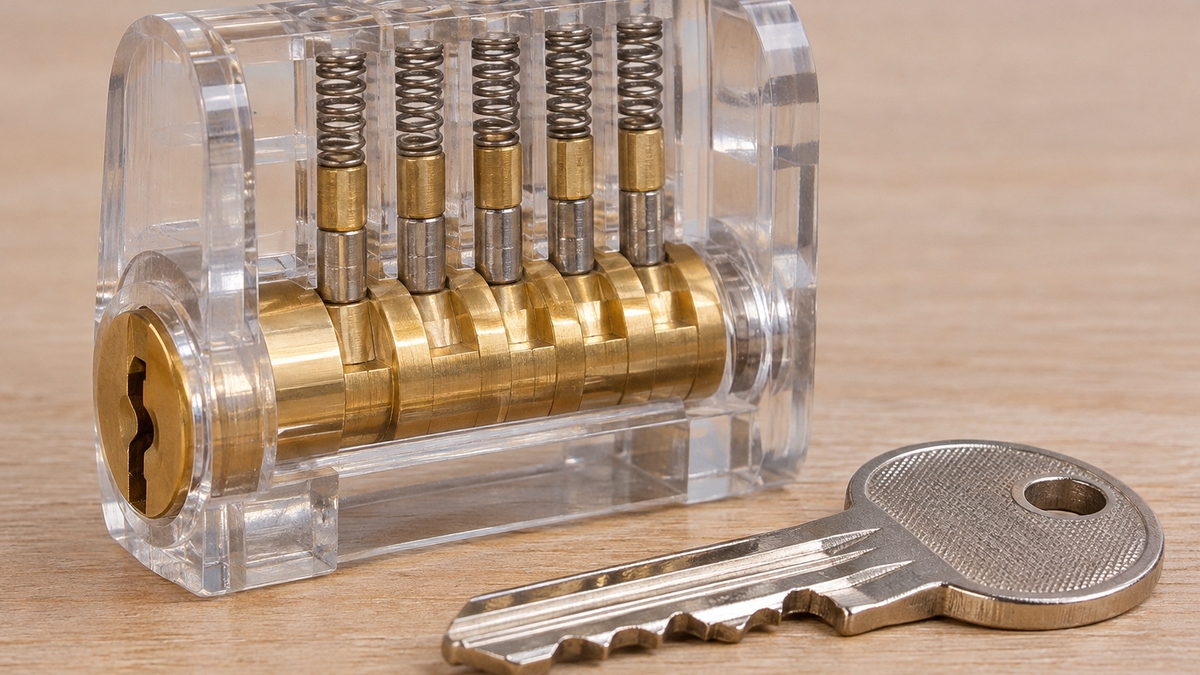
Lock picking works by reproducing, one pin at a time, the alignment that the correct key creates all at once. In a common pin tumbler cylinder, the key raises paired pins so the gap between each key pin and driver pin sits at the boundary between the rotating plug and the stationary shell. That boundary is the shear line. When every pin pair clears it, the plug can rotate. Authorized picking uses one tool to apply very light rotational pressure and another to feel and lift individual pins. Small manufacturing tolerances cause one pin stack to bind before the others. Setting that pin changes which stack binds next. The process is therefore controlled feedback, not force. This description explains the mechanism; it is not permission to work on a lock that is installed or belongs to someone else.
What happens inside a pin tumbler lock?
Yale describes the pin tumbler as a plug inside a housing with rows of spring-loaded pins of different lengths. With no key, driver pins cross the shear line and prevent rotation. A correctly cut key lifts every key pin by the required amount, aligning all pin-pair gaps at the shear line. Five- and six-pin cylinders are common, but chamber count alone does not determine difficulty. Keyway shape, spring strength, tolerances, wear, lubrication, and security-pin designs all affect feedback. For a learner, a clear or repinnable practice cylinder is valuable because it connects visible movement with what the hands feel. It also keeps training separate from household or workplace security.
Why is tension control more important than force?
The turning tool supplies the small rotational load that creates a binding order and later turns the plug. Too little pressure may let a set pin fall. Too much pressure can wedge pins against chamber walls, hide subtle feedback, bend a thin tool, or mark a soft practice cylinder. Good control feels closer to holding a page in place than tightening a fastener. Because keyways and tools vary, there is no universal pressure number. The practical goal is repeatability: begin light, notice whether a pin moves and returns, and change only one variable at a time. A learner who treats tension as the main control signal usually progresses more reliably than someone who collects many pick shapes but never develops a consistent touch.

What is a binding pin and what feedback matters?
A binding pin is the stack currently held most firmly by slight plug rotation. As it is raised in a basic training cylinder, the gap between key pin and driver pin can reach the shear line and the plug may rotate by an almost invisible amount. Useful feedback can include a small click, a change in springiness, or a subtle movement through the turning tool. None of those signals is guaranteed, and a click does not prove a correct set. A pin that feels solid may be binding, overset, obstructed by heavy tension, or simply difficult to reach. The safest learning method is observation on a transparent or cutaway trainer, followed by slow practice on a detached, known cylinder.
How do security pins change the learning problem?
Some cylinders use spool, serrated, or other shaped driver pins intended to complicate manipulation. They can produce partial rotation, repeated catches, or feedback that resembles a correct set. Beginners do not need to defeat every feature. First learn clean pin identification and tension control on a basic trainer. Then add one known variable at a time in a repinnable practice lock, documenting what changed. That progression turns confusion into a controlled lesson and avoids treating an in-service security device as an experiment. If a household lock seems unusually resistant or begins to malfunction, its behavior is not a training challenge; use its key and arrange proper service.
What should a first authorized practice session look like?
Use a stable table, bright light, eye protection when changing pins, and a detached practice cylinder that cannot secure anything. Confirm that the key works before and after the session. Limit the tool set to one comfortable hook and one correctly fitting turning tool so feedback remains understandable. Work briefly, pause when the hands tense, and record which pressure changes produced clearer signals. Stop if a tool scrapes heavily, twists, or becomes trapped. The purpose of a first session is not a fast opening. It is to identify springy, binding, and set states without damaging the trainer. A short repeatable session builds more transferable skill than a long session driven by frustration.
What lock picking cannot tell you about real security
An opening demonstration does not measure the full security of a door or padlock. Real protection also depends on installation, strike reinforcement, shackle exposure, key control, hardware condition, access procedures, lighting, and monitoring. Conversely, difficulty during practice does not prove a lock is secure; the tool may not fit, the cylinder may be dirty, or the learner may be using excessive pressure. Treat lock picking as one educational lens on mechanical tolerances, not as a complete security rating. For an occupied property, a qualified locksmith or security professional can evaluate the whole assembly and recommend changes that preserve life-safety and code requirements.
Where should readers go next?
After understanding the mechanism, compare practice locks, basic hooks, and tension tools by compatibility and training goal rather than by piece count. Keep the article educational: the useful next step is a controlled practice setup, not an installed target.
How can a learner evaluate progress without chasing speed?
Progress is clearer when the learner can describe cause and effect. Use a repeatable trainer, the same two tools, and a short sequence of observations: identify every chamber with no tension, find the first binding pin under light pressure, release the pressure deliberately, and confirm that the operating key still feels normal. Record what changed when pressure or tool angle changed. Opening time can fluctuate with fatigue, pin order, and chance, so it is a weak score by itself. Better measures include fewer unnecessary resets, less tool deformation, a relaxed grip, and an accurate explanation of springy, binding, and set states. End the session while control is still good. This kind of deliberate practice also makes it easier to recognize when the trainer, not the learner, has developed a maintenance problem.
Lawful use and professional boundaries
A lock installed on a door, gate, vehicle, locker, cabinet, or other active system can create safety, legal, insurance, and property-damage issues even when the person holding the tools believes the use is harmless. Professional locksmiths also verify identity and authority before opening or servicing a lock. The Associated Locksmiths of America positive-identification policy is a useful model: confirm who is requesting the work, what property is involved, and what authority that person has. Laws governing tools and paid locksmith work vary by state, province, and locality, so readers should check current rules where they live and travel. None of the information here is legal advice. When a lock protects occupied property, supports an emergency exit, contains electronics, is under warranty, or is already malfunctioning, stop and use the correct key, the manufacturer’s service route, property management, or a qualified locksmith.
For help choosing dedicated training hardware, read our practice-lock selection guide.
Frequently asked questions
Is lock picking the same as forcing a lock?
No. Picking attempts to align internal components without destructive force, but poor technique can still mark or damage a cylinder. Authorization is required either way.
Can a clear practice lock teach everything?
No. It is excellent for seeing basic relationships, but its materials and tolerances may differ from production hardware. Use it to learn concepts, then progress to detached authorized trainers.
Why does a pin feel stuck?
Possible causes include binding, excessive tension, awkward tool access, dirt, wear, or an overset pin. Reduce variables and stop if the tool is bending or scraping.
Should beginners practice on a front-door lock?
No. An installed lock is an active security and life-safety component. Use a detached trainer and keep a working key available.
